“To be full Greek”, The British Philhellene Lord Guilford, the Spiritual Renaissance of Hellenism, and the establishment of the first university in the modern history of Greece and Southeastern Europe

On October 14th, 1827, just days before the historic Naval Battle of Navarino, one of the most iconic, distinctive, and moving figures of international Philhellenism drew his last breath in London. Frederick North, 5th Earl of Guilford, more widely known as Lord Guilford, was an aristocrat who dedicated his life to the intellectual awakening of the Greek peoiple. Moving beyond the mere label of a “Philhellene,” he emphatically declared himself an “Hellene” throughout his life, leaving an indelibly imprint on the history of modern Greek education by founding the nation’s very first university.


The Grand Tour and the Secret Baptism

As the son of the Prime Minister of Great Britain, Lord North, Frederick was born into the heart of the British aristocracy on February 7th of 1766. Upon completing his studies at the University of Oxford, he embarked on the traditional European Grand Tour in 1790, an educational and experiential journey that was destined to alter the entire course of his life.

In 1791, he crossed over to the Ionian Islands, visiting Corfu and Ithaca before touring Epirus and Athens. He remained in the land of Attica for more than a year, immersing himself in the study of ancient Greek language, literature and culture.

His connection to Greece, however, far transcended mere admiration. In 1791, he undertook an act of extreme spiritual conversion by the standards of his time, secretly embracing Eastern Orthodoxy and taking the name Dimitrios. In Great Britain during that period, for a public official to renounce the Anglican Church meant the immediate forfeiture of their civil rights and political offices. When the astonished Corfiot priest asked him why the son of a British prime minister would make such a decision, he replied disarmingly: “To be full Greek.”


The Vision of the Ionian Academy

Lord Guilford’s grand vision was the spiritual renaissance of the subjugated nation through education, and he returned permanently to the Ionian Islands in the 1820s to bring it to fruition.
Initially, driven by his deep adoration for classical antiquity, he planned to establish the university on Ithaca, considering it the most ideal and serene setting for academic studies. However, political circumstances and the outbreak of the Greek War of Independence in 1821 necessitated shifting the institution’s seat to Corfu, the capital of the United States of the Ionian Islands, which was then under British protection.
The founding of the Ionian Academy stands as one of the most brilliant milestones of intellectual Philhellenism. The institution officially opened its doors on May 29th of 1824, marking the birth of the first Greek university of modern times.

The university began its operation with four core faculties: Theology, Law, Medicine, and Philosophy.

At a time when higher education across Europe was conducted strictly in Latin or French, Lord Guilford took a groundbreaking decision, establishing Modern Greek as the official language of both instruction and administration.


A Beacon of Hellenism and Relations with Prominent Intellectual Figures

Serving as the first “Archon” (Chancellor) of the Academy, Guilford utilised his vast personal fortune to equip laboratories, provide scholarships to impoverished Greek students from every corner of Ottoman-ruled Greece, and gather some of the most brilliant minds of the Greek intelligentsia to teach. Among the professors who staffed the chairs of the Ionian Academy were Konstantinos Asopios, Andreas Kalvos, Christoforos Filitas, Theofilos Kairis, and Petros Vrailas-Armenis.

At the same time, the Lord maintained close ties with the intellectual elite of the era. From 1821 onwards, he was in regular correspondence with Greece’s national poet, Dionysios Solomos. Solomos held a profound respect for Guilford’s work and personality, to whom he had even dedicated a sonnet written in Italian. In the surviving letters from their correspondence period between 1824 and 1827, the poet characteristically signed his name using its Latinised version, Salamon.

During a period in which international support for Greece was often measured in terms of geopolitical power, the Lord Guilford discerned that the nation’s true, long-term freedom required the creation of a robust intellectual infrastructure, he firmly believed that education and culture constitute the most powerful foundation for national sovereignty and the establishment of a free Greek state.


A Unique Library and the Attire of Greek Antiquity

One of the most peculiar and widely discussed details of daily life at the Ionian Academy was the special attire that Guilford himself designed for professors and students. Inspired by ancient Greek tradition, the uniform consisted of tunics, cloaks, and sandals, featuring distinct colorations depending on the faculty, aiming through this visual medium to underscore the continuity of the Hellenic spirit.

His greatest contribution, however, was his priceless library. For decades, Guilford traveled tirelessly throughout Europe, purchasing rare Greek manuscripts, first editions of classical authors, historical documents, and foreign-language scientific treatises. In 1824, he donated his entire personal collection, which numbered approximately 25,000 volumes, to form the core of the university library.


The End and the Legacy

The death of Lord Guilford in October 1827 deprived the Ionian Academy of its primary benefactor and patron. Despite the severe economic hardships that followed, the institution continued to operate and shape the representatives of the Greek intelligentsia until 1864. Upon the Union of the Ionian Islands with Greece, the Academy closed permanently, as its resources were transferred to support the University of Athens.

Although the majority of Lord Guilford’s valuable library was transferred back to London by his heirs and auctioned off, a significant part of it was salvaged and today enriches the Library of the Ionian University in Corfu.

Nowadays, two centuries later, the historic building of the Ionian Academy still stands imposingly in the historic center of Corfu, housing structures of the modern Ionian University and keeping alive the memory of the British aristocrat who chose to live and die as a Hellene (Greek).

Lord Guilford’s legacy remains remarkablly relevant, proving that enduring Philhellenism is that which invests in education and culture. The anniversary of his death serves as an occasion for reflection on the timeless value of the Greek language, the deep roots of Hellenism, and the vision of an education with international radiance.


The Sculpture of Guilford on an Ancient Greek Seat

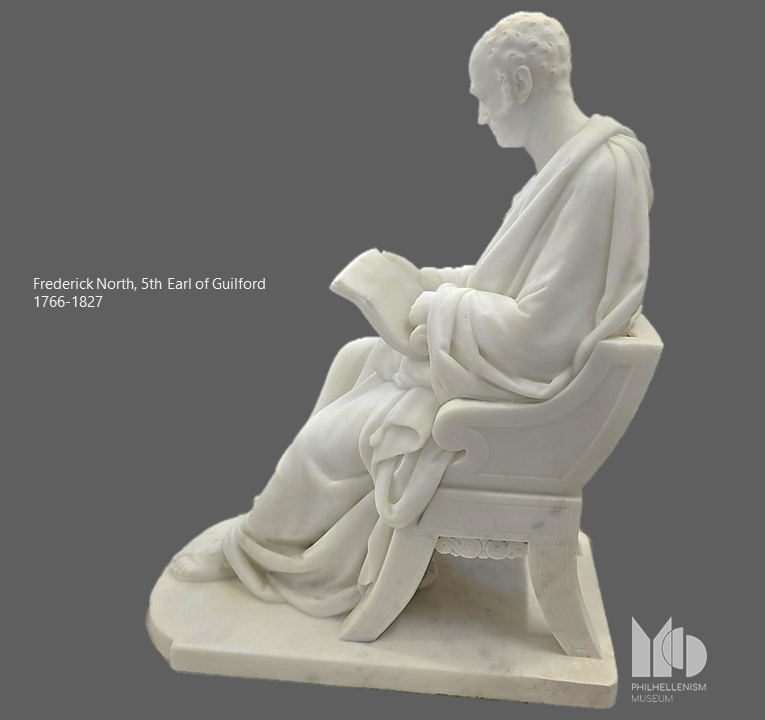
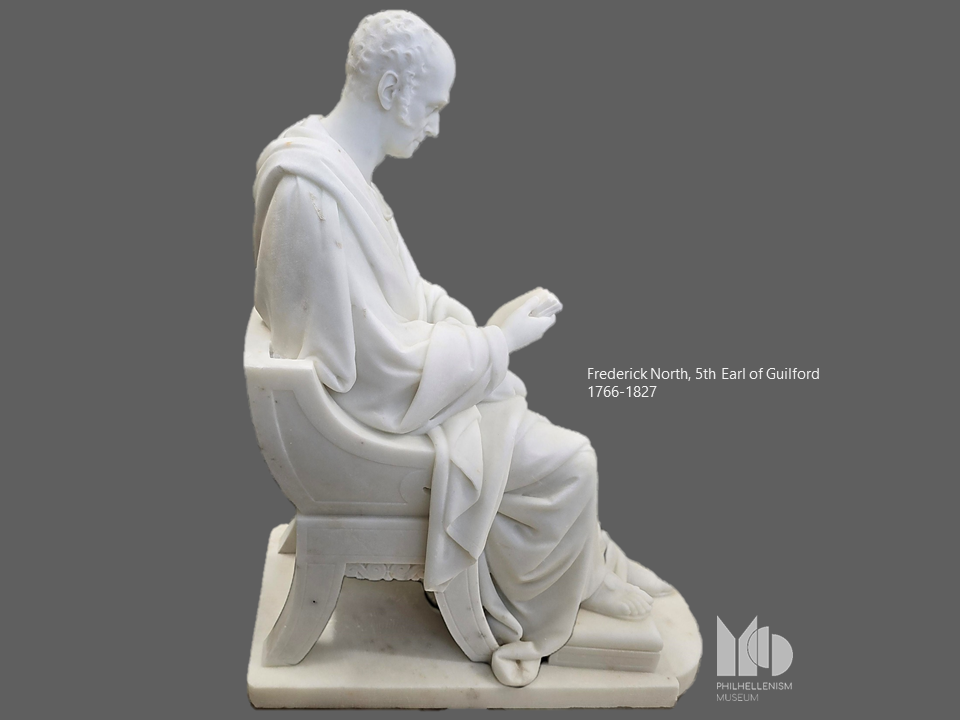
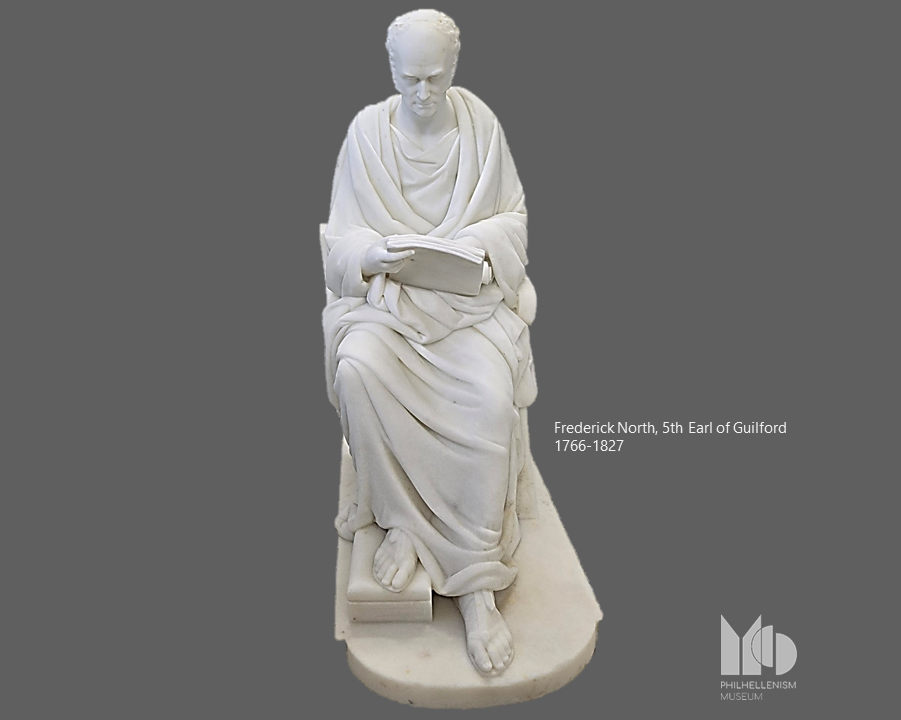
The sculpture of Lord Guilford, featured in the collection of the Philhellenism Museum, was crafted in Carrara marble. It depicts Lord Guilford seated on a traditional ancient Greek “klismos” chair, draped in a chiton (Ancient Greek form of tunic), and holding a book/scroll in his right hand. The object in his hands is no ordinary book, it represents the founding charter of the Ionian Academy, his life’s work.


Information: info@phmus.org
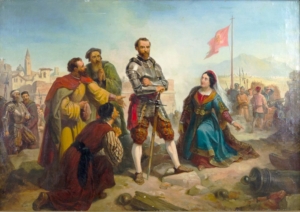
A painting by the Italian Philhellene Giuseppe Lorenzo Gatteri (1829–1884) from the collections of the Philhellenism Museum.

In this rare artwork, the distinguished history theme painter Gatteri depicts Marcantonio Bragadin (1523–1571), the heroic defender of Famagusta during the Ottoman siege (1570–71), refusing to surrender the city to them.

The female figure on the right side of the composition is a personification of Cyprus, pleading that Famagusta not be surrendered to the besiegers.

On the occasion of the anniversary of the 1974 Turkish invasion of Cyprus, the Society for Hellenism and Philhellenism (SHP) pays tribute to the fallen, emphasising that the restoration of Cyprus’s freedom and independence is primarily the responsibility of Europe and civilised humanity.

Information: info@phmus.org


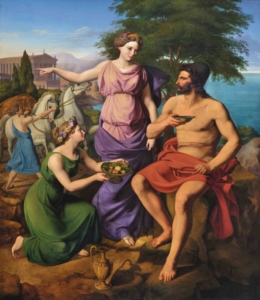
Oil painting by the German painter Carl Fielgraf (1804–1865) from the collections of the Philhellenism Museum.

In light of the recent discourse surrounding Christopher Nolan’s new film “The Odyssey”, and specifically the discussion regarding the female emancipation in Homer’s work, we present this painting to highlight that the figure of Nausicaa represents a progressive and dynamic woman.

Nausicaa serves as the archetype of a bold, compassionate, and autonomous young woman who rescues the hero. Similarly, Penelope, stands as an equal interlocutor and partner to Odysseus, possessing a profound strategic intellect that shapes the unfolding of the epic’s plot.

Homer presents advanced degrees of female emancipation, aspects that required thousands of years of cultural evolution to surpass, yet still remain unrealised today across a vast portion of the globe.

The artwork is one of the most recognisable and historically significant artifacts of the 19th century. It was first publicly exhibited in 1826 at the renowned Exhibition of the Berlin Academy of Arts (Berliner Akademie-Ausstellung), drawing the attention of critics of the time. The artist faithfully adheres to the principles of German Classicism and the Düsseldorf School, characterised by the clarity of lines, the theatricality in the figures’ posture, and the detailed rendering of the natural landscape.

Fielgraf draws direct inspiration from Homer’s Odyssey (Rhapsody VI), and the scene captures the moment when the shipwrecked Odysseus, naked and exhausted, awakens on the shore of the island of the Phaeacians (nowadays Corfu) at the sound of Nausicaa’s voice. The hero appears wild, disheveled, and full of diffidence, while Nausicaa presents a gracious noble figure; that she is the only one who is not frightened and chooses instead to assist him by offering him garments.

Information: info@phmus.org


With particular success and great emotion, in a packed Herodeion, on October 10, 2024, the big concert of the Society for Hellenism and Philhellenism (SHP) and the Philhellenism Museum took place, in the presence of the political and military leadership of the country and many diplomats, to celebrate the bicentenary since the death of Lord Byron and the Philhellenes.

The event was prefaced by the president of the SHP, Mr. Constantinos Velentzas, the Minister of National Defense, Mr. Nikos Dendias, and the British Ambassador, Mr. Matthew Lodge.

The concert, the artistic direction of which was assigned to Ms. Lina Nikolakopoulou, began with recitations of poems by Lord Byron and other Greek and Philhellene poets, by herself, the author and journalist Victoria Hislop, and the professor of poetry at the University of Oxford Alicia E. Stallings.

In the first part, the ERT Contemporary Music Orchestra appeared with maestro Mr. Giorgos Aravidis who played works by the British Philhellene composer Tom Smail and songs and music by Greek composers, related to the struggle of the Greeks for freedom.

Throughout the concert, SHP displayed the portraits of 80 emblematic Philhellenes, each with the flag of their country, on the wall of Herodeion.

This was followed by the Dryades quartet, with soprano Katia Paschou and pianist Achilleas Wastor, with philhellenic songs and music that animated the philhellenic movement internationally during the period of the Greek War of Independence.

The concert closed with the Band of the Air Force with chief musician Alexandros Litsardopoulos and the Vrilissia choir with chief musician Giorgos Ziakas, with melodies by the famous Philhellene composer, Gioachino Rossini, and songs from the work Eleftheroi Poliorkmenii by Dionysios Solomos, with music by Yiannis Markopoulos and Christos Leontis, with soprano Sofia Zova and baritone Angelos Moussikas.

The SHP honors the great romantic poet and the Philhellenes with the establishment of the Philhellenism Museum, the construction of the Philhellenes Monument on Vasilissis Sofias (in front of the War Museum), which is a decision of the 4th National Assembly in Argos and the institutionalization as early as 2021 in collaboration with the Academy of Athens, of the international Lord Byron prize awarded annually to three international personalities.

The SHP and the Philhellenism Museum have organized around 20 similar events this year, which include school and sports competitions, speeches, conferences (in Athens and Cambridge), exhibitions (at the Hellenic Parliament, the Academy of Athens, the War Museum), concerts, publications, etc. in Greece, the United Kingdom, Switzerland, Germany, etc.

Lord Byron’s contribution to the liberation of Greece

Lord Byron’s contribution to the liberation of Greece was crucial. His name, undoubtedly, is synonymous with Philhellenism internationally for three reasons.

First, with his emblematic work Childe Harold’s Pilgrimage, he highlighted Greece as the cradle of Western civilization, familiarized international opinion with this concept-belief and progressively led to the adoption of the demand that “Greece might still be free again!”.

Secondly, from the works of this most famous man in the world, a new romantic hero emerged, the Palikari punisher of brutality (like the Giaour). The particularly popular world-wide Byronic heroes dominated the philological salons, were adored by the public, were depicted in all forms of art, and once the Greek Revolution began, they were identified with Greek fighters, offering impetus to the development of the Philhellenic movement in Europe.

In 1823, the cause of the freedom of Greece was the last noble mission adopted by the great poet and it is on this altar that he sacrificed his life. This was his third and most important contribution to Greece, triggering an activism of unprecedented intensity and effectiveness, the constant sending of financial aid and volunteers, and a series of diplomatic and political actions which culminated in the Battle of Navarino and led, ultimately, to in the establishment of the new independent Greek state. Thus, Lord Byron justly entered the Pantheon of Greek heroes.

For information: Info@eefshp.org, 210.8094750


PHILHELLENES

Tribute to Lord Byron and the Philhellenes

Distinguished artists honour the “Year of Lord Byron and Philhellenism”, through works of great Greek and Philhellenes poets.

Contemporary musical composition embraces recitations and interpretations of poetry set to music, highlighting the works of internationally beloved poets: Lord Byron, Alexander Pushkin, Johanna Kinkel, Vittorio Sereni, Juliusz Slowacki, Frédéric Mistral, Kostis Palamas, Aristotelis Valaoritis.

We invite you on a musical journey from “The isles of Greece” of Lord Byron up to the “Victory” of Kostis Palamas.

Under the Sacred Rock of the Acropolis, after 200 years, Greeks and Philhellenes are united again in body, with one heart, and all together sing for Freedom and Peace!

ERT CONTEMPORARY MUSIC ORCHESTRA (ERT CMO)
HELLENIC AIRFORCE BAND (HAB)
CHOIR OF VRILISSIA MUNICIPALITY
DRYADES QUARTET

ARTISTIC CURATOR:
LINA NIKOLAKOPOULOU

MODERATOR:
ALEXIS KOSTALAS

SPECIAL GUEST:
TOM SMAIL

CONDUCTORS:
GIORGOS ARAVIDIS, ERT CMO MAESTRO
ALEXANDROS LITSARDOPOULOS, HAB MAESTRO

CHOIR DIRECTOR:
GIORGOS ZIAKAS

ORCHESTRATATION:
ACHILLES WASTOR, ERT CMO
SPIROS BAKOS, HAB

PERFORMANCE:
VICTORIA HISLOP
ALICIA E. STALLINGS
LINA NIKOLAKOPOULOU
DIMOSTHENIS STAVRIANOS
KATIA PASCHOU
ANGELOS MOUSIKAS
SOFIA ZOVA

Organised by:
SHP, Philhellenism Museum

Free entry by invitation
For reservations: info@eefshp.org
Note: Please enter a different name, email and mobile phone per invitation. The ticket with the Bar Code will be sent to each mobile phone you will register. For information you will receive messages to the email you have declared.

Under the auspices of:
British Embassy
Ministry of Culture
Municipality of Athens

Sponsors:
Captain Vassilis & Carmen Konstantakopoulos Foundation
Lilian Voudouris Foundation
EUROPEAN DYNAMICS


The Philhellenism Museum and the War Museum, in the context of the year “2024, Year of Lord Byron and Philhellenism”, inaugurated the group exhibition “… Where the arts of war and peace grew…”, with the participation of 50 distinguished Greek artists.

The exhibition is presented in the foyer of the Amphitheater of the War Museum.

A handwritten poem by Lord Byron from the archive of the Society for Hellenism and Philhellenism (SHP), became the conceptual and material body in which 50 works were deployed and narrate in modern terms the main milestones in the life and work of Lord Byron.

During the opening, the President of the War Museum, Lieutenant General Mr. Konstantinos Karamesinis, welcomed the guests and spoke about the collaboration with the Philhellenism Museum, thanking the contributors for the unique way in which the space was shaped into a new museum destination.

The founder and president of the SHP and the Philhellenism Museum in Athens, Mr. Constantinos Velentzas, referred to Lord Byron as the most famous man of his time, who was a role model for the most important artists and intellectuals. Every soul that felt suffocated in the societies of the early 19th century, wanted to be like him. For 2024, the Philhellenism Museum has presented two more major exhibitions dedicated to Lord Byron and the Byronic art on which Philhellenism was based. One is hosted at the Hellenic Parliament and the second at the Academy of Athens. All exhibitions are open to the public with free admission.

The activities of the SHP and the Philhellenism Museum in 2024 will be completed with two conferences in November 2024 (at the Museum of Cycladic Art and at the University of Cambridge), and with a big concert to take place in the Herodeion oden, on October 10, 2024, with selected artists, the orchestra and the choir of ERT.

As the exhibition is under the auspices of the British Embassy, ​​representing the British Ambassador in Athens, Ms. Katharina Arnold spoke about the intense activity of the SHP and the Philhellenism Museum regarding Lord Byron and Philhellenism.

The Philhellenism Museum houses and exhibits the largest private collection of Lord Byron’s personal effects and Byronic art, as well as 5,000 valuable historical relics and evidence related to Philhellenism.

The curator of the exhibition, Mrs. Iris Kritikou, spoke about the bold project to present a tribute of contemporary art to Lord Byron and the way in which fifty distinguished Greek artists proceeded to create an independent organic art area around and within visual, plastic, and symbolic references to the great romantic poet and Philhellene.


The exhibition is under the auspices of the British Embassy.


Participating artists:

Yannis Adamakis, Aggeliki Antonea, Lydia Venieri, Marilitsa Vlahaki, Marina Vlachaki, Andreas Georgiadis, Markos Georgilakis, Maria Giannakaki, Stratigoula Giannikopoulou, Fanis Goulis, Maria, Diakodimitriou, Frangiskos Doukakis, Argyro Driva, Stamatis Zannos, Nikos Zivas, Gogo Ieromonachou, Apostolis Itskoudis, Polina Kasimati, Andreas Kontellis, Themis Kontogouris, Filippos Koutrikas , Nikos Leontopoulos, Vassilis Liaouris, Minas Mavrikakis, Manos Batzolis, Ismini Bonatsou, Rouli Mpoua, Yiannis Brouzos, Andreas Nikolaou, Mary Ntagianta, Thodoros Papagiannis, Christos Papadakis, Dimitris Papanikolaou, Kostas Papatriandafyllopoulos, Nikos-Giorgos Papoutsidis, Nikos Perantinos, Stelios Petroulakis, Michalis Sakalis, Giorgos Saltaferos, Ifigenia Sdoukou, Stefanos Souvatzoglou, Vasilis Soulis, Kostas Spiriounis, Marina Stellatou, Praxitelis Tzanoulinos, Nikos Triantafyllou, Claire Tsalouchidi-Chatzimina, Dimos Flessas, Manolis Charos.

A bilingual catalogue will be published as part of the exhibition, and parallel actions are planned.

“… Where the arts of war and peace grew…”

Curator: Iris Kritikou, archaeologist and art historian.

Venue: War Museum, Amphitheater Foyer, Rizari 2, 10675 Athens
Duration: July 9, 2024 – September 9, 2024
Days and hours of operation: Daily, 9.00 – 19.00
Free entrance

Information:
Museum of Philhellenism | Email: info@phmus.org | T. +30 210 8094750
War Museum | E.: info@warmuseum.gr | T. +30 210 7252974


Media sponsor:

With the kind sponsorship of the Society for Hellenism and Philhellenism and the international group EUROPEAN DYNAMICS.


The Philhellenism Museum and the War Museum, within the context of the year “2024, Year of Lord Byron and Philhellenism”, are co-organizing an important group exhibition, with the participation of 50 Greek visual artists, entitled: “…Where grew the arts of war and peace…”.

This year’s bicentenary of the death of Lord Byron is a point of reference for 50 distinguished Greek artists, who honour the great romantic poet and Philhellene with their artworks.

The historic foyer of the War Museum’s Amphitheatre will host for the coming months, a multi-layered visual tribute to Lord Byron that encourages us to discover his worldwide glory in relation to his passionate love for Greece and Freedom.

Curated by: Iris Kritikou

Participating artists:

Yannis Adamakis, Aggeliki Antonea, Lydia Venieri, Marilitsa Vlahaki, Marina Vlachaki, Andreas Georgiadis, Markos Georgilakis, Maria Giannakaki, Stratigoula Giannikopoulou, Fanis Goulis, Maria, Diakodimitriou, Frangiskos Doukakis, Argyro Driva, Stamatis Zannos, Nikos Zivas, Gogo Ieromonachou, Apostolis Itskoudis, Polina Kasimati, Andreas Kontellis, Themis Kontogouris, Filippos Koutrikas , Nikos Leontopoulos, Vassilis Liaouris, Minas Mavrikakis, Manos Batzolis, Ismini Bonatsou, Rouli Mpoua, Yiannis Brouzos, Andreas Nikolaou, Mary Ntagianta, Thodoros Papagiannis, Christos Papadakis, Dimitris Papanikolaou, Kostas Papatriandafyllopoulos, Nikos-Giorgos Papoutsidis, Nikos Perantinos, Stelios Petroulakis, Michalis Sakalis, Giorgos Saltaferos, Ifigenia Sdoukou, Stefanos Souvatzoglou, Vasilis Soulis, Kostas Spiriounis, Marina Stellatou, Praxitelis Tzanoulinos, Nikos Triantafyllou, Claire Tsalouchidi-Chatzimina, Dimos Flessas, Manolis Charos.

As part of the exhibition, a bilingual catalogue will be published and parallel activities are planned: educational programmes, lectures, musical tributes, theatrical recitals, etc.

The exhibition is curated by: Archaeologist and Art Historian, Iris Kritikou.

The exhibition is under the auspices of the British Embassy.
With the kind sponsorship of the Society for Hellenism and Philhellenism and the international group EUROPEAN DYNAMICS.

Exhibition venue: War Museum, War Museum’s Amphitheatre Foyer, Rizari 2, 10675 Athens
Exhibition duration: July 9, 2024 – September 9, 2024
Opening hours: Daily, 9.00 – 19.00
Free admission

Information:
Philhellenism Museum
info@phmus.org, T. +30.210.8094750

War Museum
info@warmuseum.gr, T. 2107252974


The Hellenic Parliament in collaboration with the SHP and the Philhellenism Museum organized a particularly successful exhibition on the occasion of the 200th anniversary of the death of the great romantic poet and emblematic Philhellene, Lord Byron.

The exhibition entitled Beholding Liberty with Lord Byron’ s gaze, presents rare personal objects of Lord Byron and remarkable Byronic artworks from the collection of the Philhellenism Museum.

As a still living organism, the exhibits invite the visitor to navigate a unique route where the narration of Lord Byron’ s life and work allow the deepest comprehension of his contribution to the liberation of Greece, as well as the reason why he has been recorded in the international collective memory as the most glorious Philhellene of all times.

The exhibition is curated by the art historian Dr. Thodoris Koutsoyiannis.


Information:

Ε. info@phmus.org | Τ. +30 2108094750


GUIDED TOUR – EXHIBITION
Sunday 26 May 2024, hours 11.00-13.00
Sunday 2 June 2024, hours 11.00-13.00


The Philhellenism Museum for one more year participates in the “This is Athens – City Festival”, and invites you to discover the Philhellenes of the historical center of Athens. A guided tour of the most emblematic monuments and architectural spots of the Plaka area.

Participants will wear headphones throughout these walks to better follow the tour, which will be performed in real-time.

In the context of the 200th anniversary of the death of Lord Byron and the designation of this year as “2024, Year of Lord Byron and Philhellenism”, the Hellenic Parliament collaborates with the Philhellenism Museum and present the exhibition “Beholding Liberty through Byron’s gaze”.

Exclusively for the participants of “This is Athens – City Festival 2024”, on 26th of May, a special guided tour of the exhibition at the Hellenic Parliament is offered before it opens to the public. The tour will be conducted by the curator of the exhibition and curator of the Collection of Works of Art of the Parliament, Dr. Thodoris Koutsogiannis.

Maximum number of participants: 50
To enter the exhibition at the Hellenic Parliament, it is necessary to show a police ID.
Free admission with necessary online reservation to the Philhellenism Museum, email: info@phmus.org

Duration: 120 minutes (11.00 – 13.00)
Meeting and starting point: Anglican Church of St. Paul (27 Philhellinon Street, Syntagma) at 11.00 a.m.


Information:
Philhellenism Museum
Address: 12 Zisimopoulou, 11524 Athens | T. : +30 2108094750 | Email: info@phmus.org

Media Sponsor:

Audio Guide System Sponsor:


The SHP (Society for Hellenism and Philhellenism) participated on April 19, 2024 in the historic ceremony organized by Trinity College of the University of Cambridge, in the Library, next to the iconic statue of Lord Byron.

A representative of the SHP addressed a greeting, laid a wreath and presented gifts to the university administration.


On April 20, 2024, the SHP participated in a ceremony organized by Nottingham City Council at Lord Byron’s historic home, Newstead Abbey, which is now a museum. A representative of the SHP delivered a greeting, exchanged gifts and then visited the tomb of Lord Byron at the Church of St Mary Magdalene, Hucknell.


Information:
Philhellenism Museum, T. 2108094750, E. info@phmus.org


Links:
www.phmus.org
www.eefshp.org
www.facebook.com/PhilhellenismMuseum


Media sponsor: