Article by Theo Dirix


Resumé: Since medieval times the city of Liège in Belgium has been a centre of armament manufacturers. After the French period that lasted until the fall of Napoleon in 1814-1815, the Dutch King William I of Orange-Nassau invested heavily in the metal and weapon industry of the former Prince-Bishopric of Liège. Officially neutral in the Greek conflict, the government formally denied, and claimed to prevent, the exports of arms to the Greek insurgents, carefully protecting its Ottoman market. Initially commercial motives prevailed among all manufacturers, but soon, inspired by the Greek struggle for Freedom, Belgian nationalism also grew in Liège, facilitating weapon deals to Greece.[1]


“My friend,” said the child, the Greek child with blue eyes,
“I wish but for some powder and balls!”[2]

In one of his Philhellenic verses, Victor Hugo, the best-known French author of the era, stages a child who desires weapons more than toys. More than a poetic or romantic myth, the history of Philhellenism also tells the story of economic gain and human loss.

By the end of the eighteenth century, the city of Liège hosted seventy to eighty manufacturers of weaponry, exporting pistols, guns, cannons, knives, bayonets, ammunition, flints, powder and uniforms, mainly to France.

Once in power of the United Kingdom of the Netherlands,  comprising todays Kingdoms of Belgium and the Netherlands and the Grand Duchy of Luxemburg, the business minded Dutch King William I of Orange-Nassau invested heavily in the industries of the southern provinces: in the textile industry in Ghent in Flandres and in the metal and the weapon-industry of Liège. Another key of his policy was the promotion of exports.

In 1823, the Dutch Chargé d’affaires in Constantinople, Gaspar Testa, informed his home office that a Dutch ship, le Brisier under Captain Piet Bakker, had sailed to Milo(s) with a cargo of weapons sent by Stephano Paleologo(s) to the Greek insurgents in the Peloponnese. Together with that other Greek merchant in Amsterdam, George Tomasachi (Tomazinos), he already played a pivotal role in the support of the Greek cause. As a matter of fact, Paleologo had sent donations from the Greek committees in Amsterdam and Londen to his family, the Xeno’s linked to the leadership in Hydra. This particular arms deal reported by the Dutch envoy,  however, alerted the central government, emphasising its neutrality.

Obviously this didn’t prevent King William I to further develop the trade with the “East” and the “Black Sea”. One of his representatives, Jean-Baptiste De Lescluze, a trader from Bruges and President of the Chamber of Commerce in Ostend, travelled to the region between 1821 and 1825.  Unknown to the public but confirmed by Dutch diplomatic archives, it also appears that a manufacturer of Liège, D. D. Ancion and Co, had signed a profitable contract of three years with the Ottoman Court. The goods passed through a trading house in Amsterdam, Sigritt. By the end of 1824, so the Dutch envoy reports, the first orders had arrived. The Ottoman market was so lucrative that other arms manufactures from Liège, Philippe-Joseph and his brother Louis (Jean-Louis) Malherbe, also approached the Dutch envoy in Constantinople, after their introduction to the Ottomans by Jean-Baptiste De Lescluze had failed. His commercial mission to the court, indeed, had been aborted in 1821. Sailing to Athens instead, he had sold some of the weapons he carried to the insurgents. When later that rumour circulated in Constantinople, it was strongly denied.[3]


Pistols from Liege (Philhellenism Museum / SHP collection)


While the King and his Government scrupulously protected their commercial interests in the Ottoman market, the Greek cause had started to stir the minds of the people.

In 1972, the Belgian academic Lutgard Wagner-Heidendal unveiled that the Malherbes, mentioned above, were members of the masonic lodge La Parfaite Intelligence, one of the major catalysers of the Greek Committee of Liège. It also appears that the Committee approached committees elsewhere in Europe with the suggestion of providing weapons against donations. With the contributions they had raised in two successful concerts and some other events in Liège, a cargo of weapons manufactured by Mathieu-Joseph Malherbe de Goffontaine had been shipped to Greece in July 1826, as proven by Wagner-Heidendal.


The program of June 3, 1826, of one of the many concerts that took place in favor of the Greeks in Europe. The aim of these events was to raise money for the financial support of the Greeks, and to promote the rights of Greece (Philhellenism Museum / SHP collection).


More details about that shipment stem from a letter, recently rediscovered by the author, in which Nestor Aron announces the imminent departure of La Jeune Emilie with 43 Philhellenes under the command of Raybaud and a cargo of: “4,000 boxes of biscuits, 500 rifles from the city of Liège, 30000 (x) of gun powder, flints, trousers and medical supplies”.[4]

For diplomatic and political reasons, the Government officially denied the weapon trade with Greek insurgents. We can only guess in how far it tolerated or monitored the deals, as did the French and Italian authorities when shipments passed through Marseille or Livorno. Studying the matter, a former Greek Consul in Liège only discovered one small piece of papier, half burned, unsigned and dated 1826, in a private collection outside Liège. The snippet is a rare illustration of the secrecy but also reflects an honest bargain with reasonable prices, so he concluded.


List of a shipment of weapons sent to Greece in 1826


Killing two birds with one stone (pun intended), a section of Liège’s industrials and elite made the transition from commercial interests to political involvement, undermining the policy of the Dutch occupation, as an omen of its complicity in the Belgian revolution in 1830.

Theo Dirix[5]


References

[1] For this introductory article the author relied on three sources: 1) the exhaustive but forgotten study in Dutch by Lutgard Wagner-Heidendal: Philhellenism in the Kingdom of the Netherlands, published in 1972 by the Royal Academy for Science, Literature and Arts of Belgium; 2) a short article in French by Efstratios Mavroudis, a former Greek Consul in Liège: Relations de Liège avec l’insurrection Hellénique La Presse – La Fourniture d’armes (no further references, with the illustration, assessed here: https://ojs.lib.uom.gr/index.php/BalkanStudies/article/viewFile/887/895 ), and 3) B. van de Walle, J.B. De Lescluze, in: Handelingen van het Genootschap voor Geschiedenis, Brugge, 1959, p. 76-88, 1960, p. 154-188.

[2] Closing verses of the poem The Greek Child from Victor Hugo’s Les Orientales, as translated by G.B.: in: The Metropolitan Magazine, Volume 36, Saunders and Otley, 1843, p. 375.

In The Greek Boy (Les Turcs ont passés là.) {XVIII, June 10, 1828.}, that same verse has been translated as: “Oh, give me your dagger and gun!”, as a reply to ”Would’st thou a trinket, a flower, or scarf, Would’st thou have silver? (https://www.gutenberg.org/files/8775/8775-h/8775-h.htm#link2H_4_0033 )

[3] The story of Jean-Baptiste De Lescluze who saved the lives of at least 1100 Greeks who fled the occupation of Athens in 1821 by evacuating them from Pireaus to Salamina, and his offer to negotiate a commercial treaty with Ypsilanti surely merit a separate article.

[4] Recently rediscovered letters addressed to a Belgian Philhellene, (to be published here soon).

[5] Theo Dirix, freelance author, www.theodirix.com ; tafofiel@gmail.com

The Philhellenism Museum presents, in cooperation with the American Embassy, American Philhellenism


Letter of 1824 (SHP collection, Philhellenism Museum)

Article by George Thomareis


The letter constitutes a precious part of Greek history. It is a letter written on 28 January 1824 in New York by some J.J.L. addressed to some Gracie in Baltimore.

In the draft letter a lot of information is included, mainly on the emblems (Constantne’s Cross, “ΤΟΥΤΩ ΝΙΚΑ” etc.) the symbolisms and the flags of the Revolution. The information concerning the flag are coming from American compatriots who had seen it in Psara!

The most standing of all, however, is the page with the sketches of the flags and mottos, drawn with Chinese ink in 1824. Maybe world’s first of our flag on paper!

What did actually the contents of the letter mean?

The Philhellenic movement in America was great at that time. In various cities (New York, Boston, Baltimore, Pittsburgh, Cincinnati etc.) Philhellenic Committees were founded which gathered funds and clothing to be sent to Greece from various events such dances, concerts etc. for the relief of the hunger-striken population.

The result of this great mobilisation was the dispatch in 1827 of eight ships with food and clothing to Greece (On philhellenism in America see Stephen A. Larrabee, The American experience of Greece 1775-1865, New York 1957).

The New York Committee organised a dance on 8 January and it seems that a member of the Baltimore Committee was asking some information for the decoration of the ballroom for the dance they were preparing.

The dance of the Baltimore Committee had in fact taken place in February 1824 with great success. A nice description of the evening and the decoration of the ballrooms with Greek flags-evidently copying the ball of N. York- was published in the newspaper Ellinika Chronica [Hellenic Chronicles] published in 1824 in Missolonghi (The description was republished by M. Anninos in The Philhellenes of 1821, p. 63-65 and C. Lazos in America and her role in the 1821 Revolution, vol. I, Papazisis 1983, pp. 462-463).


The letter reads:

“In answer to your inquiries respecting the Greek Cross and Flag, I send you the following:

The Cross adopted by the Committee of decorations, as the most appropriate to be displayed at our Greek Ball on the 8th of January was the Cross of Constantine.

It is asserted by Historians that it was seen by that Emperor in the Heavens with the inscription ΤΟΥΤΩ ΝΙΚΑ. By this conquer it occasioned his conversion to Christianity.

In a vision, which it is also said he had the same night, he was directed to adopt the Cross or Labarum as his standard and to inscribe the same on the shields of his soldiers. A further reason for exhibiting this cross was that Prince Ipsilanti fought under it as his banner in all his recent battles with the Turks. It is in the following form of the name of Christ in Greek representing the 2 first letters.

The proportions in this monogram, as taken from an ancient coin, should be:

the perpendicular piece to be of the same length with the transverse piece measuring from the lower part of the curve to the ground – as some authors say that when seen by Constantine, it resembled a flame, our object was to make it as near that color as possible, and after making numerous experiments, we covered it with a bright foil giving nearly a flame colour when a strong light was thrown upon it. Our inscriptions were in letters of gold in a white ground.

There is as yet no National Flag in Greece – each Island or State having its own.

There are three known to us:

– Cross Blue on a White Field.

– Stripes Blue & White alternately.

– Anchor Blue in a white field.

The first of these was only exhibited as harmonizing best with our own and as it is the only one yet seen by some of our countrymen at Ipsara.

I have no doubt it would have given the Committee pleasure to send on the Greek Flag made for us to Baltimore, but the size of the Theater required a flag of 80 Feet length and as economy was studied by us as much as possible, we sewed pieces of bunting together, which have since been taken apart and sold.

We are therefore denied the pleasure of giving this small proof of our wish to cooperate with our friends at that city”.


Note on the Philhellenism of the time

The philhellenic movement in America, around 1823-24, had erupted. In the churches there were sermons in favor of the Greek Revolution, in the theaters special performances were staged to support financially the Struggle, while from 1824 American companies sent to revolutionary Greece swords, rifles, pistols, small cannons and medical supplies!

Many Americans fought on the Greek side, such as George Wilson of Rhode Island, James Williams of Baltimore, Captain John M. Alen, a close friend of General Lafayette, William T. Washington from Washington, and others.

In various cities (New York, Boston, Baltimore, Pittsburgh, Cincinnati, etc.) philhellenic committees were established which collected money and goods to be sent to Greece, through various events, such as dances, concerts, etc. to alleviate the grief of the starving population. The result of this great mobilization was the sending of eight ships in 1827 with food and clothing to Greece (Stephen A. Larrabee “Greece 1775-1865, How the Americans Saw It”).


Mrs. Martina Hermann, visited the Philhellenism Museum, she was guided in the Museum and experienced through its collections, the birth and evolution of the philhellenic movement from the Renaissance until today.

During the visit, SHP (Society for Hellenism and Philhellenism) presented to the Embassy the biographical notes of Philhellenes of Austrian origin, who participated in the Greek Revolution and fought on the side of the Greeks.

Mrs. Martina Hermann delivered to the Museum, on behalf of the Government of Austria, a flag as a symbol of friendship between the Austrian and Greek peoples, and stated the following:

“The Greek Revolution of 1821, which later led to the founding of the modern Greek state, draws its inspiration, among other things, from the universal values of Freedom and Democracy, which have their roots in ancient Greece. Especially with regard to parliamentary democracies worldwide, these values, originating from ancient Greece, are the cornerstones of nations’ self-awareness.

We still share these basic values and principles with Greece. In addition, the relations between our two countries are very friendly and are characterized by close cooperation in the EU.

I wish every success to the Museum of Philhellenism “.


The Ambassador of Georgia Mr. David Dondua and the staff members of the embassy of Georgia visited on April 20, 2021 the Philhellenism Museum, and was guided to its 4 floors. The staff of the Museum presented to him the collections, the history of the philhellenic movement and the philhellenic art, as well as the history of many emblematic philhellenes who supported the Greek Revolution.

Mr. Velentzas presented to the Museum of Philhellenism a document of great historical importance that proves the bonds of friendship between Greece and Georgia. This is a touching letter sent to Greece in 1897 by Georgian students from the University of St. Petersburg. With this letter they express their philhellenic feelings and their support to the struggle of the Greeks.

SHP warmly thanked the ambassador for this document.

Mr. David Dondua stated the following:

“Four thousand years of shared history and close cooperation between our countries and people, are a best attestation of philhellenic spirit of Georgian nation. On our planet there is no other nation closer to us than Greeks. I am so proud to represent my country in Greece”.

The ambassador also explained that the name used for Greek in Georgian is “ბერძენი” / brdzeni, which comes from the word “ბრძენი” / brdzeni and means “wise”, while Greece is called “საბერძნეთი” / Saberdzneti, meaning “the land of the wise”.

The two sides agreed to take joint actions to promote relations between the two peoples and to organize a joint exhibition.


The Society for Hellenism and Philhellenism held a closed ceremony to mark the opening of the Special Exhibition on the “American Philhellenism” of the Philhellenism Museum on April 14, 2021.  The opening was attended by Deputy Minister of Foreign Affairs for the Diaspora Constantinos Vlassis, Deputy Minister of Defence Alkiviadis Stefanis, the Ambassador of the United States to Greece Geoffrey Pyatt, Deputy Chief of Defense Vice Admiral Ioannis Drymousis, Governor of Attika George Patoulis, Deputy Governor for Culture Maria Vidali and Deputy Mayor of Athens Skiadas.

The Museum of Philhellenism hosts an extensive and unique collection of paintings, personal items, firearms, books, and documents related to the Greek Revolution of 1821, with a special focus on Philhellenes from Europe and the United States.  This is the first time that many of those artefacts will be in public display.

The Museum host a special exhibition on “American Philhellenism” with the support of the U.S. Embassy in Athens, as part of its campaign “USA-Greece: Celebrating 200 Years of Friendship” commemorating Greece’s Bicentennial.  The “American Philhellenism” exhibition features impressive objects from American Philhellene, including Dr. Samuel Howe’s personal collection, lithographs of other prominent Philhellenes like the poet Fitz Halleck, books published by Everett and Ticknor, news articles from the 18th century, as well as various letters and other documents showcasing the role of the American Philhellenes in the Greek revolution.

Although the Museum is currently not open to the public due to the pandemic restrictions, it offers an online virtual tour for visitors from Greece and throughout the world:

www.phmus.org

https://phmus.org/the-museum/episkepsi-online/

During the opening ceremony, Deputy Minister Vlasis congratulated the Philhellenism Museum and the U.S. Embassy on their initiative to promote American Philhellenism, and highlighted the strong bonds between the United States and Greece.

The U.S. Ambassador to Greece Geoffrey R. Pyatt said, “Our Embassy is very proud to support the museum’s exhibition on ‘American Philhellenism’ as part of our year-long campaign to commemorate the Greek bicentennial and the two hundred years of friendship between our great democracies. American society has been enriched from its earliest days by our relationship with Greece and the Greek people.  And I’m extremely confident that even two hundred years from now, the United States will continue to stand by Greece as our trusted ally and partner.”

The Governor of Attica Mr. Patoulis, the Deputy Governor of Attica Mrs. Vidalis, and the Deputy Mayor Mr. Skiadas, stressed the importance of the Museum, and the important role of American philhellenism in building the strong bonds between the Greek and American people.

For more information about the Museum of Philhellenism contact: www.phmus.org,

www.eefshp.org
email: info@phmus.org
Τel: 210.8094750


The Ambassador of Switzerland, Mr. Olaf Kjelsen, visited the Museum of Philhellenism on Monday April 12, 2021.

During the tour of the Museum, he had the opportunity to learn about the exhibits, the history of the philhellenic movement, and the important role of thousands of the Swiss Philhellenes, who fought valiantly on the side of the Greeks as volunteers or supported the actions of the philhellenic committees in Switzerland.

The Society for Hellenism and Philhellenism (SHP) referred to the important role played by the Swiss banker and politician Jean Gabriel Eynard, close friend of Capodistrias and great benefactor of Greece.

SHP presented to the Swiss Ambassador an anniversary medal it issued on the occasion of the 200th anniversary of the Greek Revolution, in the honor of the great Philhellene Jean Gabriel Eynard.

On the occasion of the 200th Anniversary of the beginning of the Greek Revolution, the Swiss Ambassador Mr. Olaf Kjelsen presented to the Museum of Philhellenism on behalf of the Swiss Parliament a Swiss flag as a symbol of the ties of friendship between the Swiss and the Greek people, based on principles and values of classical Greece.

SHP thanked the Swiss Ambassador Mr. Olaf Kjelsen and Mr. Andreas Aebi, President of the National Council of Switzerland, and assured that it will continue to promote with its work our common cultural values and the continuous philhellenism as a virtue for the progress of our societies.


The Ambassador of the Federal Republic of Germany, Mr. Ernst Reichel, and his wife, Ms. Anne Decrue Reichel, visited the Museum of Philhellenism on Thursday, April 8, 2021.

During their tour of the Museum, they had the opportunity to learn about the exhibits, the history of the philhellenic movement, and the role of thousands of German Philhellenes, who fought valiantly on the side of the Greeks as volunteers or supported the philhellenic committees in Germany.

SHP presented to the German Ambassador two anniversary medals it issued on the occasion of the 200th anniversary of the Revolution, which honor two important German Philhellenes. Ludwig I, King of Bavaria, great benefactor of Greece who financed the struggle of the Greeks and General Norman, who led the Greek army in the battle of Peta and sacrificed himself for Greece.

The German Ambassador Mr. Ernst Reichel, handed over to the Philhellenism Museum, on behalf of Dr. Wolfgang Schäuble, President of the German Parliament (Bundestag), a German flag sent by the German Parliament on the occasion of the 200th Anniversary, and said during the flag handover ceremony the following:

“I am pleased to hand this flag of the Federal Republic of Germany over to you on behalf of Dr. Wolfgang Schäuble, President of the German Bundestag. This flag was used in the German Bundestag, which is why it shows some minor traces of usage. Allow me to thank you for your dedication in making the roles Philhellenes played in the Greek Revolution of 1821 and its aftermath known to the general public. The largest part of these Philhellenes were Germans, who gave their hearts, fortunes, and sometimes even their lives in support of the Greek cause. They were inspired by the ideals of the Greek war of independence, which set into motion a process of historical and state-building importance for large parts of Europe. These processes, eventually, helped shape the parliamentary democracies our countries are today. It is therefore of great symbolic value that this flag, originating from the German Parliament, the heart of German democracy, will from now on be displayed in the Philhellenism Museum. May it serve as a symbol of the strong bonds between Germany and Greece in a united Europe. I wish you personally and the Philhellenism Museum, once it is allowed to open to the public, all the very best and much success.”

SHP thanked the German Ambassador Mr. Ernst Reichel and the President of the Bundestag, and assured that it will continue to promote with its work the common cultural values of the German and Greek people and the continuous philhellenism as a virtue for the progress of our societies and European integration.

The Philhellenism Museum exhibits, among others, important works of art by German painters and artists on the subject of the Greek Revolution, as well as objects and documents, on the history of German Philhellenes who fought on the side of the Greeks or supported the German Philhellenic Committees.


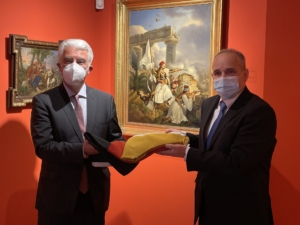
The photo shows the Ambassador of Belgium in front of an important painting by a Flemish painter of 1650 depicting a scene from the Iliad (the abduction of Helen).


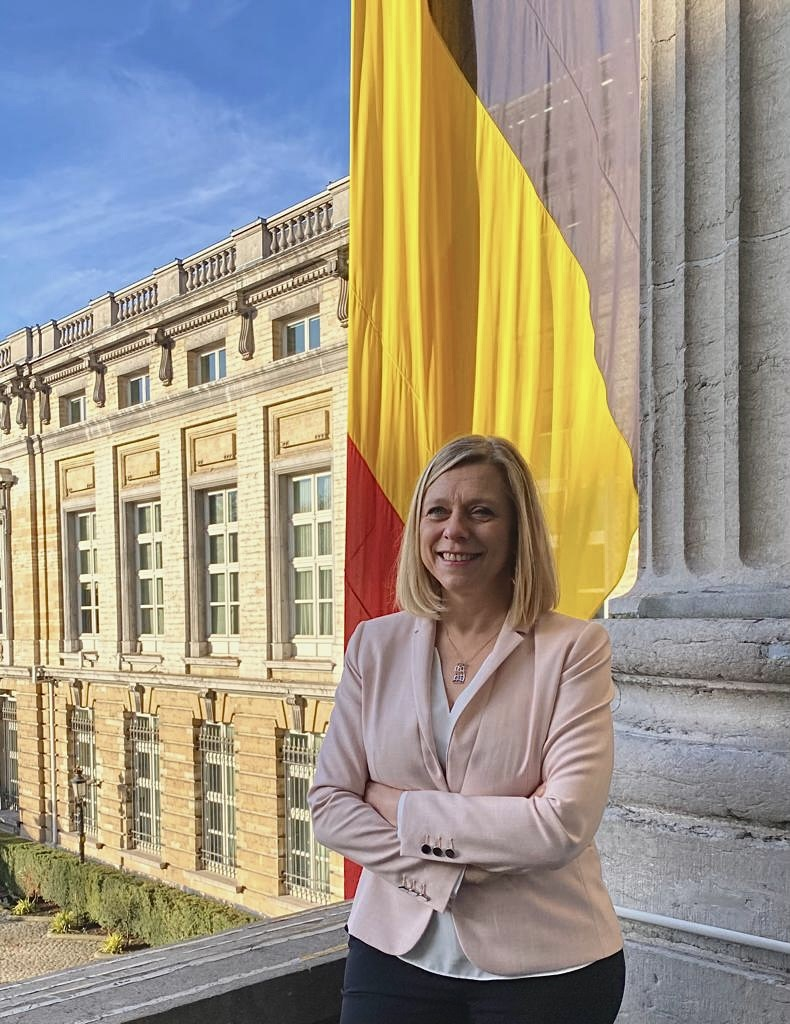
The Ambassador of Belgium, Ms. Françoise Gustin, hands over to the Society for Hellenism and Philhellenism (SHP), a flag offered by the Belgian Parliament, on the occasion of the 200th anniversary from the Greek Revolution and the opening of the Philhellenism Museum.

SHP warmly thanks the Speaker of the Belgian House of Representatives, Ms. Eliane Tillieux, and assures that it will forever honor this flag which will symbolize the long-standing bonds of friendship between the people of Belgium and Greece.


Τhe Speaker of the Belgian House of Representatives, Ms. Eliane Tillieux


The Philhellenism Museum honors, among others, Belgium, which has contributed in many since the Renaissance the promotion of the Hellenic culture, as a cornerstone of Western civilization and the European integration.

The Philhellenism Museum exhibits works of art by Belgian painters on the theme of the Greek Revolution, as well as the history of Belgian Philhellenes who fought in Greece on the side of the Greeks. It also presents the actions of the Philhellenic Committees operating in Belgium.

One of them is Augustin De Lannoy (December 28, 1798, July 6, 1826), who died in Andros.


SHP thanks the Belgian diplomat and Philhellene Mr. Theo Dirix, who assisted with his research the actions of SHP to study the biographies of the Belgian, Dutch and Luxembourgish Philhellenes who supported the struggle of the Greeks for national independence.


The Ambassador of Austria Mrs. Poppeller was given a tour of the Museum of Philhellenism. The representatives of the Museum had the pleasure and the honor to present to her the evolution of the history of Philhellenism, the exhibits of the Museum, as well as paintings by artists from Austria of the 18th and 19th centuries.

During the visit, SHP (Society for Hellenism and Philhellenism) presented to the Embassy the biographical notes of Philhellenes of Austrian origin, who participated in the Greek Revolution and fought on the side of the Greeks.

The photo shows Ambassador Poppeller next to a painting with a Greek mythology subject by the great neoclassical painter Angelika Kauffmann (1741-1807).

Reference was also made to the Zografeio School of Ioannina, Greece, which honors in the context of the celebration of 200 years, the Austrian Philhellenes. The Zografeio School is named after an emblematic family of National Benefactors of Greece, the Zografou family, who connect the Greek people with Vienna and the friendly people of Austria.